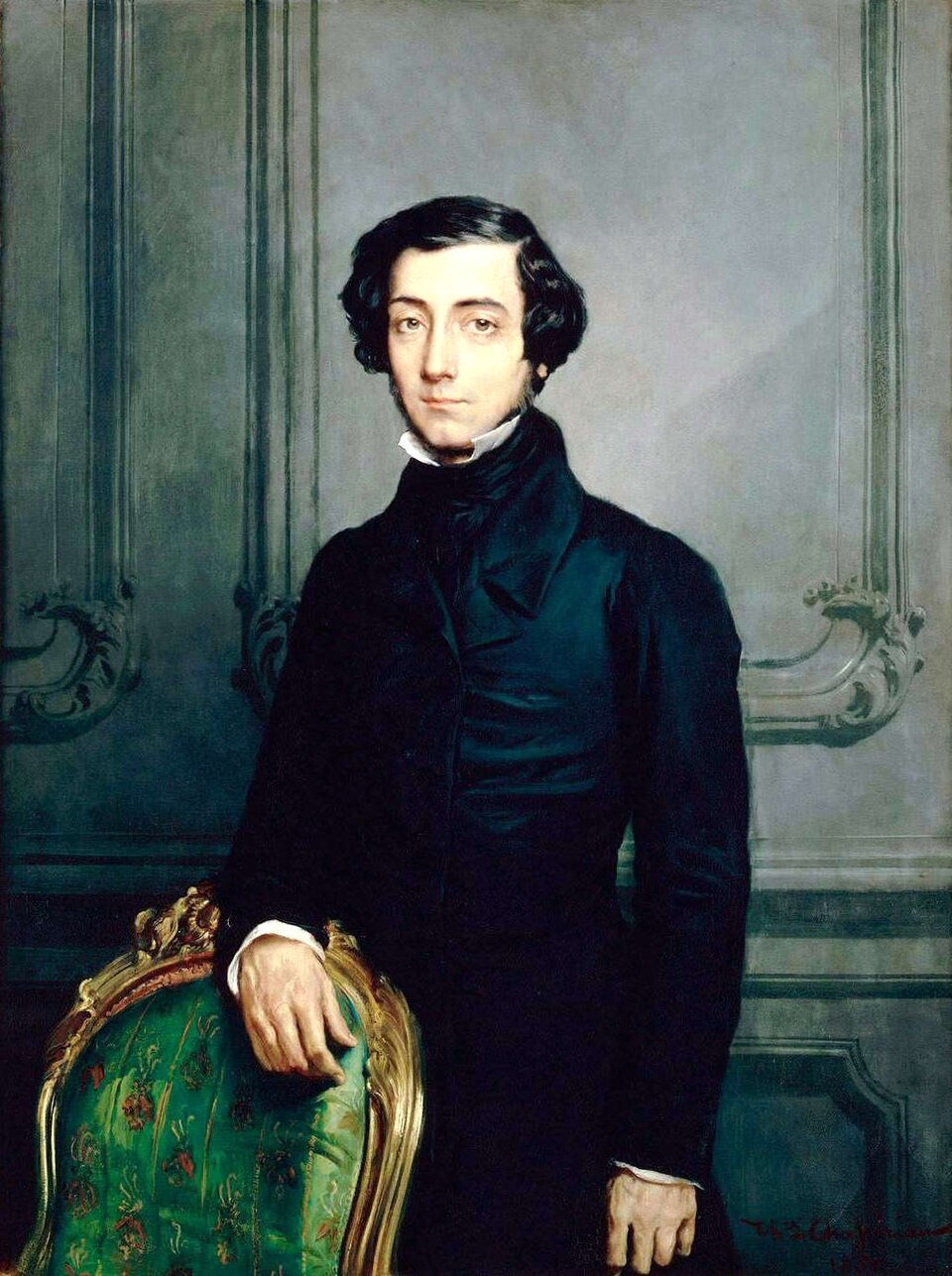
Alexis de Tocqueville (1805–1859) was a French philosopher, historian, and politician, one of the fathers of liberal thought and a precursor of sociology. He is famous for having analyzed the strengths and dangers of democratic societies, especially in his work Democracy in America, written between 1835 and 1840.
In April 1831 Tocqueville, who was a magistrate, was sent by the French Crown to the United States of America, which had been born only about fifty years earlier, and he remained there for a year. What caught his attention was the absence, in the new social system, of privileges of birth and closed estates, and the possibility for all to begin from a relatively similar level in social competition. It was from the observation of this reality that his study took shape, published in two parts after his return to France, and long regarded by educated European classes as a basic text for understanding the United States of America.
Professor Holloway, why was democracy able to take root so successfully and so early precisely in the United States, which, 250 years ago, was after all a visionary but also precarious “social experiment”? What were the historical, social, and cultural factors that made the American experience unique?
Well, on this topic my thinking has been very much influenced by Alexis de Tocqueville, so I would begin with him. Tocqueville emphasizes two things, and perhaps we could broaden it out into a third. When he speaks about origins, he insists on what he calls the “point of departure,” the nature of the first settlements. One point he makes, and that I think is very true with respect to the stability of American democracy, is that the bulk of the first settlers were middle-class people; they were therefore already relatively equal among themselves.
An Absent Aristocracy
Were there attempts to found, or in some way to transplant, an aristocracy — like the one that governed European states — into the United States?
Yes, but Tocqueville tells us that these attempts did not work very well, because there was so much land available that people could simply move away and thus get out from under the dominion of any landlord. Of course, this also involved deeply regrettable things, such as the displacement of Native Americans, whom the settlers would run up against. Nevertheless, the project of establishing an aristocracy in the United States, even though some tried, did not take root. If we think, for example, of the Plymouth Colony, where the Puritans landed, we see that they were middle-class people. There was already a kind of equality among them, and that became the basis of their democracy.
Without a Democratic Revolution
Did America have an advantage from the start?
Tocqueville thinks it is important that America had democracy from the beginning, and without the need for a democratic revolution. Revolution creates many animosities, hostilities, turbulence, and social dislocation; it also creates a class of displaced or dispossessed aristocrats, often people of considerable ability, who preserve long-lasting resentments and think it is their duty to attack democracy. In America there was really nothing like that.
Tocqueville comes back to this theme several times: the progress of American democracy is more steady and more tranquil because it was not the product of a revolution.
Tocqueville insists on democracy as a “social condition.”
The term can mean many things. What comes to mind immediately for us is political democracy, that is, self-government through elections and things of that kind. But the bare minimum Tocqueville has in mind is what he calls the democratic social condition: a society, in other words, without aristocracy. Everyone has to work; there are no great concentrations of landed wealth protected by legal privilege. That model, typically European, was never really transplanted to America. Laws of primogeniture were abolished rather early, and Tocqueville says that when you do that, you create the conditions for democracy, because you tend to produce equality. He has a nice passage where he says that, with the law of primogeniture, aristocracy seems to “sprout up from the ground.”
A Decisive Law of Inheritance
That never happened in America. A law of equal inheritance tends to grind every large concentration of property into dust. To this I would add another point: the political religion of the first settlers, especially those in New England. The South was a different case; slavery was an aristocratic institution that Tocqueville regarded as a regrettable anomaly. But he thought the dominant character of the country came from what the Puritan settlers brought. In his view their religion supported democracy. They were not Catholics; they did not have a monarchical and aristocratic model of church governance. Everything passed through the congregation: people voted to choose the pastor, and the community directed things. Their belief that the highest affairs of a human community — namely, the management of a church — could be conducted democratically led them to think that the more ordinary, secular affairs of the community could also be administered in that way, and it also gave them the habits and the practice necessary to do so. For these reasons, I agree with Tocqueville that democracy proved stable and took root quickly in the United States — or rather, already in the American colonies.
London’s Benevolent Neglect
I would add one thing that Tocqueville does not discuss: for a long time the colonies lived under what is called “benign neglect,” a benevolent neglect on the part of Britain. Only after the mid-eighteenth century, when the troubles really began, did the British ministry try to interfere with the government of the colonies. For the first hundred years or more, it essentially left them alone. I think this too helps explain why democracy took root in America: the colonists considered themselves part of the British Empire and were loyal to the Crown and the king, but for more than a century they were able to administer themselves and their democratic practice on their own.
Which insights from Tocqueville’s analysis remain most relevant today?
Tocqueville develops much of his analysis through the comparison between aristocracy and democracy. He is quite detached, and he is careful not to take sides in the way we might expect today, simply saying that democracy is better than aristocracy.
Something “Vulgar” Remains
At one point he says that democracy is more just than aristocracy; but clearly he also thinks aristocracy is more elevated, that it heightens the tone of society when there is a ruling class that does not have to work and can devote itself to culture, to the life of the mind, and to activities of that kind. There is something “vulgar” about democracy, not necessarily in a negative sense, but in a descriptive sense: everyone has to work for a living, and their concerns are therefore very pragmatic. Tocqueville analyzes these differences deeply. Different social conditions produce very different kinds of human beings. Tocqueville is interested in drawing out the strengths and weaknesses of both, and especially those of democracy, with a view to correcting them.
His great concern is to preserve the conditions of human freedom and human dignity within democracy, because he thinks there are democratic tendencies that can undermine them. Democracy, if it is not guided correctly, really does have a propensity to become despotic and dehumanizing. Those are tendencies he wants to correct.
But there are also strengths in the new system.
I have already mentioned one: Tocqueville says that democracy is more just. However elevated and refined one may think aristocracy is, it is hard to get past the fact that whole classes of people remain stuck in conditions of dire poverty and illiteracy, without any possibility of advancement. In democracy, by contrast, there is social mobility: people can make their own way and change their condition if they apply themselves. Another advantage of democracy that he mentions is that it tends to produce a highly energetic society.
Fatalism in Aristocratic Societies
In aristocracies, among the peasant class, Tocqueville sees a great deal of fatalism: they know they cannot improve their condition, and so they are driven to dwell in imagination on the next world. They are very pious because they have little to hope for from this life. In democracy, by contrast, everyone is agitated and on the move, because they believe that by their own efforts they can improve their situation. This gives rise also to folly, imprudence, and misconduct; but on the whole it is beneficial, because many people work very hard to improve their own condition and the reality around them. Under democratic conditions one therefore obtains much prosperity and accelerated material progress. A third strength for Tocqueville is widespread sympathy or compassion: democratic peoples are, in a certain sense, nicer. This aspect has always fascinated me personally. Tocqueville essentially says that in an aristocracy the ties of allegiance and loyalty are extremely powerful. Morality is strongly inclined toward self-sacrifice. One has duties to one’s lord and does everything those duties require, regardless of one’s own self-interest. For his part, the lord, if he is a good lord, looks downward in the same way along the chain of obligation. There are reciprocal obligations, and one is bound to respect them. In this sense, aristocratic morality is more selfless, more altruistic, and more oriented toward the group. But it is also narrow, because it does not think much about duties toward humanity as a whole. Tocqueville quotes a French noblewoman of a few centuries earlier who, in her letters, speaks of a peasant revolt. Writing to her daughter, she says more or less: “The weather here is fine, the season is good… Oh yes, we hanged a couple hundred peasants in the public square to teach them a lesson.” Tocqueville observes that one might think this woman is a monster, but she is not: she cares about her family and her servants. She simply has no clear conception of what it means to suffer if one does not belong to the condition of gentlemen.
The Bonds of Compassion Expand
In democracy, by contrast, the bonds of sympathy and compassion extend in large measure to the whole human race. The flip side is that they are weaker. Tocqueville seems to think that democratic peoples do not want to see anyone suffer, and certainly do not want to hurt anyone; but they do not necessarily want to exert themselves very much to help others either. So it is both a strength and a weakness.
Does Tocqueville imagine any correctives?
This is an important part of his project. One great weakness is the risk of arriving at the “tyranny of the majority.” It may sound strange to us contemporaries, but for Tocqueville democracy is not necessarily the same thing as a free society. A free society is one in which there are checks on power that are actually effective. One of the things he admires about aristocracy is that there are limits on power built into the social structure. The king is, in essence, the most powerful aristocrat, but the dukes and earls taken together are more powerful than he is, and therefore they prevent him from ruling despotically. His power is checked by what we call “intermediate powers.”
The Church, of course, was also very powerful in feudal societies, and that too was historically a check on absolute power: the king had to take it into account. In the Middle Ages we have examples of rulers subjected to public penance because they had done something wrong.
Think of Henry II of England after the killing of Thomas Becket, Archbishop of Canterbury, on December 29, 1170: he had to undergo a public flogging. This shows the strength of an intermediate institution capable of checking power. Tocqueville’s concern is that in democracy nothing like this arises spontaneously. There are only many equal and relatively weak individuals, who do not have much power in relation to the state. This is where his worry about the “tyranny of the majority” comes from.
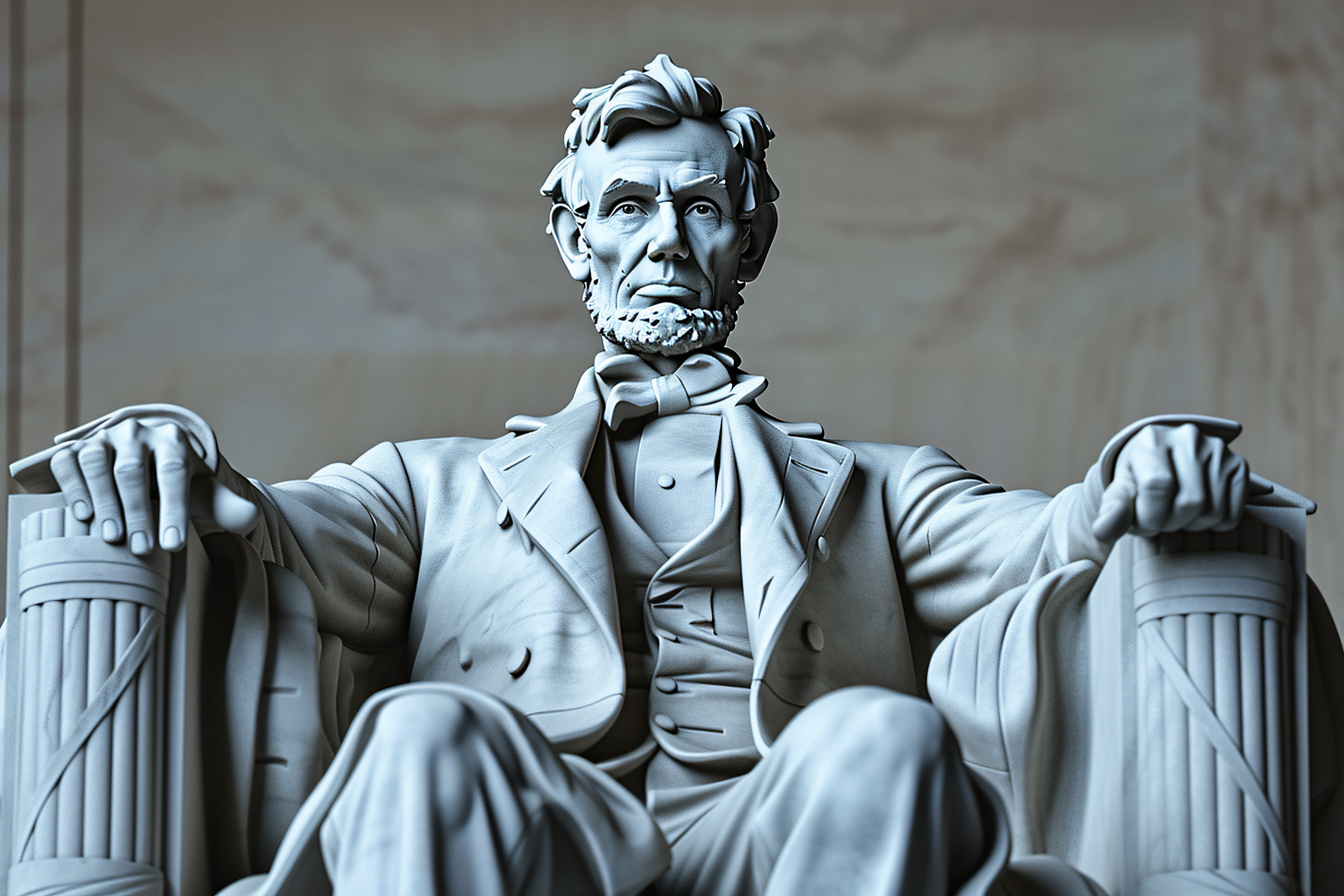
Almost prophetic, one might say.
What is the majority if not a kind of “corporate individual,” with interests distinct from those of the minority and capable, like any individual, of abusing its superior power? It is therefore important that the majority be, in some way, formed and restrained. Among the elements Tocqueville considers important for this purpose is the spirit of religion widespread in America. Writing and observing in the 1830s, he notes that Americans differ theologically: there are already Catholics, many Protestant sects, and they disagree about how to worship the Creator. Yet they agree on the rudiments of morality. This seems to me one of his fundamental and excellent observations. Tocqueville says that no one in America has been so bold as to claim that everything is permissible in the interest of the majority — a maxim that would legitimize every future tyrant. It is very wholesome that the majority in America believes in the existence of a power superior to itself, God, and that it thinks it must give an account of its actions to Him.
For this reason, preserving religion within democracy is a very important part of Tocqueville’s project. In one passage he even says that Christianity should be preserved at all costs in modern democratic societies because of what it contributes to them politically.
Another element that tempers the tyranny of the majority is political decentralization. In the United States there is federalism: the Constitution does not gather all power into the hands of the federal government, but distributes it also among the states. In a certain sense this is analogous to the relationship between king and lords: the states, together, can limit the federal government; or conversely, if the states behave tyrannically, the federal government can intervene to correct them.
Establishing Powers in Competition and Balance
We have seen this in American history, for example with the civil rights movement. Civil rights were being denied, especially in the southern states, to African Americans, and it was the federal government that intervened to protect them. In other cases, instead, it has been the federal government that behaved abusively, and the states pushed back. Tocqueville is interested in this balance.
He also admires the American “spirit of association.” Something we might perhaps call “subsidiarity” today.
Americans were very capable, at least in Tocqueville’s time and probably still today, of creating voluntary organizations that do much of the work of society. By uniting individuals, these associations make the group more powerful than the individuals would be in isolation.
There is an interesting passage in which Tocqueville compares the centralized nature of the French state with what he sees in America. He says that a Frenchman, faced with a storm or a disaster that knocks down buildings, tends to stand with his arms folded waiting for the state to come and rebuild. Americans, by contrast, set to work: they create an association and act.
I am reminded of when the Missouri River flooded in 2019 and, instead of discussing who was responsible, as people would in Italy, people immediately came together to organize themselves and fill sandbags.
That is exactly the kind of thing Tocqueville had in mind. There are a couple of examples I think about from time to time. When my children were little, I read them Laura Ingalls Wilder’s books, such as Little House on the Prairie. That dimension comes through very clearly there: settlers in the middle of nowhere who immediately build churches and schools on their own, without having to depend on anyone else. About fifteen years ago, a tornado destroyed a large part of the city of Joplin, Missouri. I went there shortly afterward for a project in the Teaching American History program, funded by the federal government for the training of American history teachers, in cooperation with school districts and nonprofit organizations. The tornado had only recently passed, and the town had already rented a Walmart, gutted it, and turned it into a high school. They had done it themselves, and it was ready for the start of the new school year. That is what Tocqueville admired. He says that in an aristocracy this kind of initiative arises almost naturally: if a member of the aristocratic class becomes aware of a social problem and decides to do something about it, he already has a network of people around him, ready to act for him. The association comes into being almost automatically. Americans do not have this; they have to build it from the ground up, and Tocqueville thinks they are very good at doing so.
Does he point to other elements of weakness?
Tocqueville distinguishes carefully between what is specifically American and what is characteristic of democracy. And, he says, when European nations become more democratic, they will see these phenomena appear as well.
Two dangers seem especially serious to him: individualism and what he calls “democratic materialism.” Aristocracies do not have an individualistic spirit; everyone is connected to someone else by a chain of obligations, upward and downward. The family also has a different importance than it has in democracy, because it often possesses a stable dwelling. It endures over time, in the imagination of its members, much more readily than in a democracy, where the family estate is sold and dispersed. In democracy those bonds are broken.
Less Class Consciousness
There is also less class consciousness in democracy: there are rich people and middle classes, but people are constantly rising and falling; many of the rich began in the middle class, and vice versa. Therefore those deep differences are not produced. Americans consequently develop a spirit of individualism. Individual responsibility is a good thing; but Tocqueville has in mind something problematic: isolation from society, withdrawal from public life, the failure to take responsibility for common affairs. People do not feel the same sense of duty. One of the dangers that follows from this is what Tocqueville calls “democratic despotism,” a concept different from the tyranny of the majority. It is important to make this clear: these are different dangers. The tyranny of the majority occurs when the majority is politically active and interested, determined to have its own way without regard for the rights of the minority. Democratic despotism, by contrast, arises when the majority is politically apathetic and uninterested; it does not participate, and the government is captured by whoever manages to dominate it. Most people do not take an interest because they are too wrapped up in small, petty, individualistic concerns. There is a very sharp remark in Democracy in America, when Tocqueville says that in America “every man’s mind is continually revolving around a very petty object: himself.” That is individualism.
Democratic Hedonism
The other problem is materialism, or what Tocqueville calls “democratic hedonism.” I think one still sees it today: Americans are very interested in physical comforts and pleasures, and this is a result of the democratic social condition. Tocqueville offers a kind of psychology of this phenomenon. He says that what makes people very interested in comforts is not possessing them without difficulty, nor being completely deprived of them; it is having enough to get the taste for them but not enough to be satisfied. For this reason he observes, very interestingly, that in an aristocracy the aristocrats are not really so hedonistic: a fine house, servants, and privileges are simply part of the texture of their life. As for the peasants, they do not have enough experience of these things to envy them or to think constantly about how to obtain a larger house or a new car. In a middle-class culture, however, such as the American one, produced by democracy, exactly what I have described takes place: one has enough to desire more, but not enough to feel satisfied. Therefore one thinks constantly about how to obtain more. Tocqueville is careful to say that he does not regard this hedonism as depraved. Most Americans, he says, are not given over to extreme forms of vice: they have to work for a living and cannot abandon themselves entirely to pleasures. The pleasures they seek are mostly innocent. But Tocqueville thinks they loom too large in their imagination. He regards it as in some way dehumanizing to think so much about material comforts. There is the danger that these pleasures, though innocent, will come between the soul and God and lower the standard to which the human being ought to aspire.
Here too, then, Tocqueville returns to religion as the great corrective. He observes with satisfaction that, in the midst of all the activity and pursuit of gain he sees in America, on Sunday everything stops. Today that would probably no longer be the case, but two hundred years ago people went to church on Sunday and heard noble sermons about the destiny of the human soul, the beauty of virtue, and duties toward God and neighbor. For Tocqueville this is an essential corrective. Otherwise materialism would get out of control: it has in itself something degrading, and it also causes people to neglect politics, because they are too absorbed in the pursuit of wealth. To participate in political life, one has to take time away from work; if one is unwilling to do so, politics risks being dominated by the most ruthless minority, the one most determined to pursue its own interests.
The Positive Civic Role of Religion
Tocqueville argues that religion played an important role in sustaining American democracy, while remaining separate from political power. Is the principle of a secular state still widely accepted in the United States? The United States is usually described as a more religious society than Europe.
That is a very interesting question, and I have some reflections on it; Tocqueville has some as well. He insists very strongly that the separation of church and state in America makes religion more powerful than it would otherwise be. According to him, it is a mistake, especially in a democracy, for religious leaders to think they can strengthen religion and make it more socially influential by tying it to the power of the state. For him, the opposite happens.
As for his personal beliefs, he is rather cagey; he identifies himself as a Catholic, but from his biography it seems that he went through a crisis of faith. Perhaps, at the most difficult point, he was the kind of person who had lost faith but wished he had not. I remember a letter to a friend in which he speaks of his crisis and adds that he does not boast of it at all. He was aware of the existence of aggressive secularists who wanted to debunk Christianity and destroy it, but he did not belong to that camp, whatever his personal convictions may have been. In Democracy in America he makes clear that he is looking at Christianity from a sociological and political-theory point of view. He does not defend it on theological grounds, but because he considers it necessary to keep democracy sane and decent.
The Human Heart Has Unsatisfied Longings
Tocqueville thinks that human beings are religious by nature: the human heart has longings that this life cannot satisfy. He once said, “I spend a little time each day with three men: Rousseau, Pascal, and Montesquieu.” In that remark there is Pascal: the human heart has longings that will not be satisfied in this life; it has a longing for the infinite, for immortality. Therefore, Tocqueville says, if religion wants to be powerful it simply has to address itself to this longing. People will respond spontaneously. It is not necessary to have the power of the state on one’s side. He thinks that in Europe much of the hatred of Christianity derives from the political alliance of the Church with monarchies. If that alliance were broken, people would return to their natural religiosity. In this sense America is a good model of the necessary secular state. Tocqueville does not believe in any form of theocracy. Religion offers a useful moral influence, and this influence is most powerful when it is indirect: when it informs public opinion and provides moral principles for public debate. But if someone tried to take control of the American state and impose an official religious establishment, for Tocqueville that would be an enormous mistake.
No “Christian Theocracy” in Sight
I think this is still true today. I know that some people think America is moving toward a kind of Christian theocracy, and I have heard accusations of “Christian nationalism.” But in my experience, having followed American politics closely for a long time, even the most conservative Christian activists have no interest in creating a theocratic state or establishing an official national religion, as exists in England with the Anglican Church. What interests them is that traditional Christian moral principles influence policy and public debate; as citizens, they have the right to do that as much as anyone else. In this sense they seem to me very “Tocquevillian.” The First Amendment to the Constitution, which forbids Congress from passing laws establishing a state religion, is so deeply ingrained in American society that it is hard even to conceive of such a project. I do not think people want this. The accusations arise, in my view, because in America there is a much more secular current of opinion that views any religiously motivated political activity with deep suspicion and tends to label it “theocratic.”
One of the interesting aspects of modern democracy is that in all our societies there is a strong social dynamism. There are people who see religion and traditional morality primarily as sources of oppression from which to be liberated, and people — among whom I include myself — who regard them as precious sources of meaning, not to be abandoned. This does not necessarily mean wanting to impose them by force on others. But I do think that many of the “culture wars” in modern societies arise precisely from this difference.
Looking beyond the United States, democracy no longer seems to be expanding globally as it once did. Why, in your view, is it so difficult to see it flourish in many parts of the world? Or, put differently, what conditions are necessary for democratic institutions to become established?
Let me answer first for myself, and then add something about Tocqueville. I am not a careful student of global democratic movements, nor a comparative anthropologist or scholar of comparative politics. But I do think it is common sense to say that modern democracies emerged out of a particular cultural context, one that took a long time to develop, and that this context does not exist everywhere in the world.
The ground is different.
Exactly, it was different and had been prepared for a long time by many interesting developments that did not take place elsewhere. As for Tocqueville, I think he needs to be understood correctly: in Democracy in America he is guided by a kind of philosophy of history. He regards democracy as the wave of the future. Democracy is what is coming; nothing can stop it. If one looks back seven hundred years, Tocqueville says, one sees that everything that has happened has advanced democracy, whether men wanted it or not. Even its enemies have advanced it. I think Tocqueville is sincere, but he says this also in order to moderate the aristocratic opponents in Europe, those who think it is their duty to restore monarchy or something similar. In essence he tells them: yours is not a constructive enterprise, and it will not succeed; you are the kind of people who could make a positive contribution to democracy by taking a leading role and ennobling it, but you will get nowhere by trying to undo it.
A Providential Evolution
He goes so far as to say that democracy is a providential fact and that God Himself wants it to happen. Whoever tries to undo democracy is therefore setting himself in opposition to God. This is an important appeal to European aristocrats, so that they may understand that they will not be able to restore the world of their ancestors. The future will in any case be a different world. Tocqueville also says that he thinks democracy and the spread of equality are destined to happen in the Christian world, or among the Christian nations. There is a passage late in the book in which he speaks of the ancient world and observes that even the political communities we call democratic were not truly such, because they rested on a vast class of slaves. Think of Athens: even the most enlightened thinkers of antiquity took slavery for granted.
Then Tocqueville drops a very powerful line: “Jesus Christ had to come down to earth to teach men the simple idea that all are equal in their dignity and their worth.” I therefore believe that, at some level, Tocqueville thinks that Christian revelation, or the emergence of Christianity, laid the groundwork for the birth of modern democracy.
Modernity, a Product of Christianity
The question becomes very complicated here, because the societies born from that Christian context have developed, over the last two centuries, a secular spirit that often comes into tension with Christianity. I think John Paul II understood this as well; and I think that a learned and acute modern Church, such as the one represented by him and by Benedict XVI, understands that modernity is in some way a product of Christianity, but also ends up becoming hostile to it in certain respects. Tocqueville has a similar concern. The ground was Christian, and yet in modern democracy there is often a great deal of hostility toward religion: materialism, individualism, and a rigidly rationalist spirit are the ground from which this hostility grows.