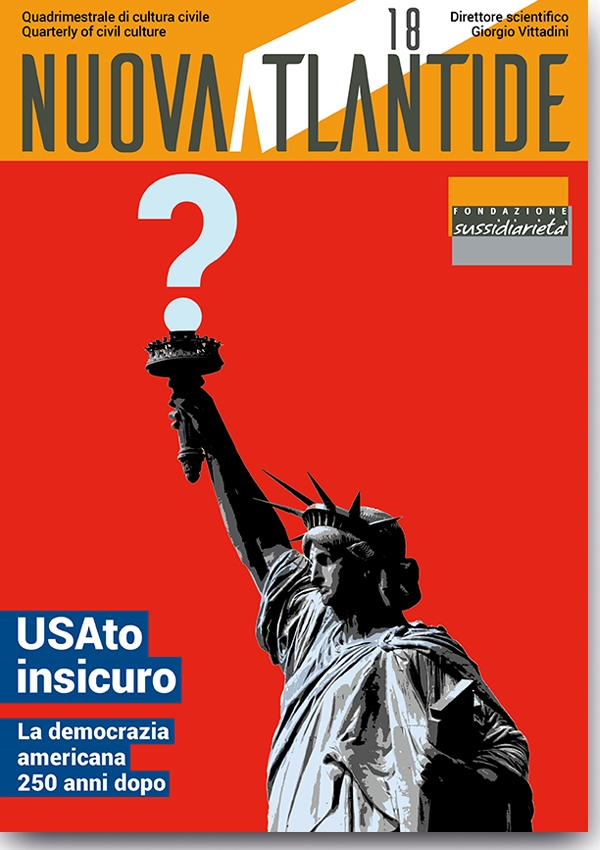
Behind the driving force of the Declaration of 1776 lies the encounter between natural law, classical republicanism, and liberalism: a union of political freedom and the Christian religious tradition that proved decisive for the success of the American constitutional experiment. Then came the fork in the road: on one side, Dewey’s democratic progressivism; on the other, Martin Luther King’s Thomist moral rationalism.
The Declaration of Independence is often read as a blueprint for procedural democracy. Human beings are equal and cannot be ruled without their consent. Appealing to this “sacred right of self-government,” Stephen A. Douglas famously asserted the right of the people of every state and territory to choose for themselves whether to retain or abolish slavery. Abraham Lincoln, facing Douglas in the 1858 Illinois Senate race, would have none of this. Consent cannot be the basis of slavery. “As I would not be a slave, so I would not be a master. This expresses my idea of democracy. Whatever differs from this, to the extent of the difference, is no democracy.”
Against Douglas’ amoral majoritarian democracy, Lincoln insisted that the Declaration announced “an abstract truth, applicable to all men and all times” and that indifference on the question of slavery is “penetrating the human soul and eradicating the light of reason and the love of liberty in the American people.”
The Spirit of Freedom and the Spirit of Religion
Lincoln’s defense of natural rights directs us to the full meaning of the Declaration of Independence as part of the Western intellectual and political tradition. The Declaration orders consent and political institutions toward freedom and happiness, the latter of which implies moral order, virtue, and a conception of the good life. For all the perennial efforts to make the Declaration into an avatar for enlightenment liberalism, the spirit of classical republicanism and of Christian natural law pervade its text.
The Founding generation’s synthesis of natural law and natural rights is encapsulated in the Declaration’s repeated emphasis on happiness as an end. The inalienable rights for the protection of which “governments are instituted among men” include a right to the “pursuit of happiness.” The less well-remembered passage that follows the right to alter or abolish existing forms of government, summarizes the aim of responsible statesmanship: those who undertake to alter or abolish government are under an obligation to “establish new government, laying its foundations on such principles and organizing its powers in such form, as to them shall seem most likely to affect their safety and happiness.”
The end of government, like the end of human action, is happiness. Employed by a generation of statesmen reared on Aristotle, Plutarch, Tacitus, and Cicero, happiness evoked the classical ideal of eudaimonia or felicitas, if not the Christian ideal of beatitudo. To that generation, happiness was a matter of human flourishing—beata vita—not the gratification of appetites or mere security. Freedom is then too simple of an end. Safety and happiness suggest something more capacious: freedom within a system of laws that accommodates, perhaps encourages, human flourishing. The pervasiveness of classical republicanism in the Declaration is reinforced by its repeated invocation of the virtues: prudence, patience, candor, courage or “manly firmness,” public spiritedness, justice, rectitude, fidelity, and honor.

Moreover, the Declaration grounds the rights and duties that constrain government as external standards, rooted in natural law, not simply tradition or consent. The text emphasizes that peoples are governed by “the laws of Nature and of Nature’s God;” that the equality and inalienable rights of human beings are endowed upon them by their Creator; that there is a “Supreme Judge of the world” to whom men may appeal for the “rectitude of their intentions” and a “divine Providence” upon which they may depend for protection.
Tocqueville later described this distinctive synthesis between Christianity and liberalism as a marriage of the spirit of religion and the spirit of freedom. The early American republic he observed was at once the home of religious fervor and the home of religious liberty—the American Founding is bookended by religious revivals in the form of the First and Second Great Awakenings, which are in turn accompanied by the disestablishment of churches in the American states between the 1770s and the 1830s. The premise of the alliance of freedom and religion was not religious skepticism, but confidence that moral virtue and true religion are more likely to flourish in a system of freedom than one of coercion. Diverse Americans of the Founding and early republic embraced the idea that saving faith cannot be produced by coercion; that churches can be vibrant without being established; and that voluntary associations can adequately cultivate the virtue necessary for republican self-government.
Historical Relativity and the Attack on Natural Rights
The Declaration’s synthesis of natural law, republicanism, and liberalism—the alliance between freedom and religion—has been a constant site of contestation. We have already noted Stephen Douglas’ reduction of its principles to popular sovereignty and Lincoln’s decisive defense of natural rights. The 20th century witnessed a subtler effort to detach the Declaration from its the natural law foundations. Arguably, it’s most powerful spokesman was John Dewey, who casts a long shadow in American education and politics.
Dewey saw himself as recovering a moral basis for democracy, not discarding it. Liberalism, in his estimation, needed to be rescued from a worn-out combination of Lockean natural rights, laissez faire economics, and an unwarranted reverence for inherited constitutional forms.
Against this doctrinaire natural rights liberalism, he sought to appeal to the democratic moral vision of Thomas Jefferson. Dewey found in Jefferson a democratic faith in the capacity and right of every generation to craft its own laws and institutions—an antidote to the unreflective reverence for inherited constitutional forms. And he read the Declaration’s emphasis on the pursuit of happiness as a rejection of the centrality of property in Lockean liberalism. As he put it in Freedom and Culture, “The right to pursue happiness stood with Jefferson for nothing less than the claim of every human being to choose his own career and to act upon his own choice and judgement free from restraints and constraints imposed by the arbitrary will of other human beings[.]”
Yet, Dewey’s vision of a new moral foundation for democracy differed dramatically from the Declaration’s synthesis of Christian natural law, classical republicanism, and modern liberalism. As he wrote in Liberalism and Social Action, citing Bentham and Hume approvingly, “Natural rights and natural liberties exist only in the kingdom of mythological social zoology.” Had the Founders and their intellectual heirs understood that the scope and content of liberty is historically relative, “they would not have frozen it into a doctrine to be applied at all times under all social circumstances.” Rights are not constraints on positive law derived from Nature or from nature’s God. They, and other standards of good government, are derivative of sociological and historic conditions. “[E]ffective liberty is a function of the social conditions existing at any time.”
Sensible of the tenuousness of a standard of right that rests on a merely sociological basis, Dewey saw an “urgent…need for a faith based on ideas that are now intellectually credible.” He proposed an elevated faith in the capacity of a people, working experimentally through democratic institutions, to choose just laws without recourse to fixed standards of justice or a religious and intellectual tradition.
The Recovery of Natural Law
Dewey’s effort to displace the natural law foundations of the Declaration did not go unchallenged in his own day. One of the more thorough contemporary responses can be found in Calvin Coolidge’s Sesquicentennial address on the Declaration in 1926. But it’s most authoritative and lasting refutation would come from Martin Luther King, Jr. in the midst of the civil rights struggle of the 1960s.

Confronting racial caste, King resurrected the American synthesis, appealing in his letter from Birmingham jail to Plato, Augustine, and Aquinas. His account allied Socrates’ defiant insistence before the Athenian jury upon the imperative of the unhindered pursuit of truth with Aquinas’ confident insistence that human reason is imperfect but adequate to discover it.
King grounded liberalism in natural law. “A just law is a man-made code that squares with the moral law or the law of God. An unjust law is a code that is out of harmony with the moral law. To put it in the terms of St. Thomas Aquinas: An unjust law is a human law that is not rooted in eternal law and natural law.”
According to King, the capability of human beings to reason well about the compatibility of human law and natural law is basic to civil disobedience. “Thus it is that I can urge men to obey the 1954 decision of the Supreme Court, for it is morally right; and I can urge them to disobey segregation ordinances, for they are morally wrong.” The validity of positive laws is determined by their conformity to a created order that human beings can access through reason.
This is emphatically distinct from a liberalism grounded in moral skepticism or in a socially-constructed democratic morality. The liberalism of the Declaration, as King (rightly) understands it, affirmatively relies on the capacity of reason to apprehend what is right by nature—that is, what makes for a good life and how best to pursue happiness. And it places upon citizens a duty to act in accordance with reason—to be, in both the individual and the collective sense, a self-governing people.
The Declaration saves its skepticism for the capacity of political institutions to serve as the principal means of pursuing happiness. Government is expected to secure the conditions for the pursuit of happiness, those conditions being principally security and freedom. But the pursuit of the highest human ends, especially salvation, is mediated by voluntary association rather than coercive regulation.
In this light, the natural rights republicanism embodied in the Declaration is not a departure from the Christian and classical traditions, but an elaboration of them. The Declaration’s foundational claim is that freedom is imperative for human beings because they are fitted to pursue a happiness that political power is inadequate to confer upon them, but the pursuit of which is insecure without a well-founded government framed by a self-governing people.