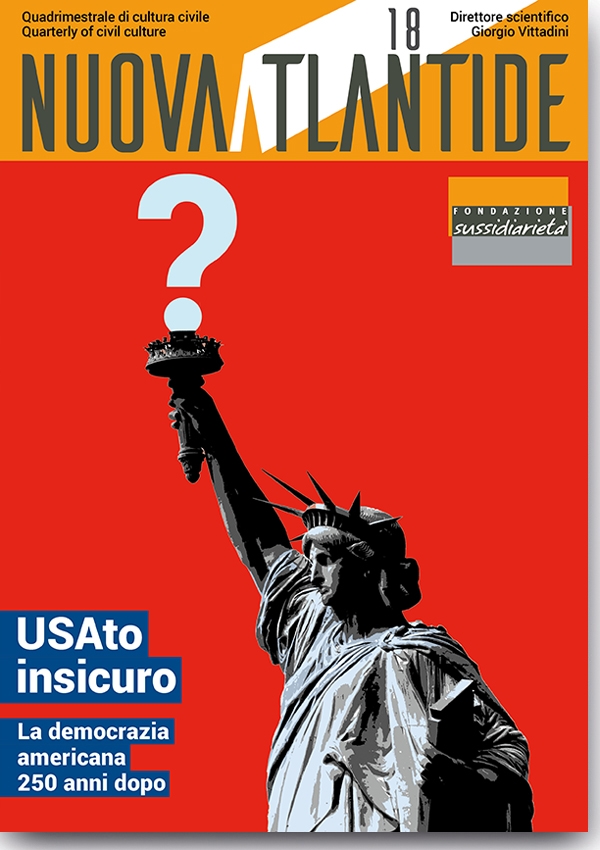
There is something new going on in US politics. If Democrats want to send Trump packing, they have understood that they can’t simply raise the banners of their most urban and radical slice of the electorate. They have to start talking to the country again about the “fundamentals” of politics, with the 2028 presidential race in view. Alexandria Ocasio-Cortez, for example, a New York congresswoman and an emerging figure on the left, called the first phase of the woke movement “crazy” in an interview on ABC’s “This Week.”[MC1]
Michael Driessen is an American scholar who pays close attention to the ideals behind politics and to its relationship with religion. He divides his time between the United States and Rome, where he teaches political science and international relations at John Cabot University.
“We are in a very interesting moment,” he says, “and in a certain sense it shows that democracy is at work in the United States. There is new room for political experimentation and innovation right now, and I think that’s a good thing. I’m not convinced that Ocasio-Cortez is a truly viable presidential candidate yet (maybe she will become one over the next two years), and I’m not sure she’s fully given up on woke positions. Instead, I think she understood that things had gone too far in that direction. In a couple of years, the Democratic Party might look quite different from today: issues like Palestine, the economy, and the ongoing wars have profoundly changed the political landscape. When Trump returned to power, he tried very aggressively to break the power of progressive cultural institutions, going after universities, liberal media outlets and institutions like the Smithsonian Institution, in an attempt to strip any government narrative of elements he deemed to be woke. But I think that many Democrats today also think that the peak woke period was excessive and politically costly: positions like Kamala Harris’s on transgender issues in the 2024 campaign didn’t pay off. Today it seems to me that the left has, at least temporarily, toned down that emphasis. That doesn’t mean, however, that woke, as a whole, has disappeared.”
Another area where the Democrats seem to be shifting is the growth of social-democratic ideas, which in the United States have always been a minority view. Bernie Sanders ran for the White House, but he was never seen as someone who could pull the entire party in his direction. Is there really room today for a social-democratic position in American politics?
In recent years there has been widespread dissatisfaction with the “democratic” label: the failures of the Biden administration, especially toward the end of his term, and the fact that Donald Trump was reelected, have brought to the fore a desire for something different, especially among younger generations. Many scholars and pollsters, however, think that most Americans and most Democrats remain closer to the center than the positions championed by democratic socialism. There is deep dissatisfaction with the right, and I think that will be enough to push an important segment of voters toward the Democratic Party, but that doesn’t mean that there is a mandate for the full leftward turn of some candidates. What is more, the nature of our two-party system will make it very hard for democratic socialism to become the face of the party anytime soon. I just don’t think the numbers are there yet, especially in some of the swing States, and so I think it would be difficult for a social democrat to win a national election, even though they are undoubtedly a new and interesting element today. With the midterm elections ongoing, I’m curious to see what happens. The real question is: if the Democrats win by a landslide, will they return to the same old policies?
Does Islam carry any weight?
There is a growing number of Muslim Americans engaged in politics today, and the situation is changing. In terms of demographics, however, Muslims still represent a fairly small part of the electorate: only about one percent of the US population compared to, for example, twenty percent of the population who identifies as Catholic. But their presence has grown, and it has been very visible recently in the debate over the war in Gaza, among other things. In Michigan, for example, the Democratic nominee for the Senate, Abdul El-Sayed, has been on the front lines of debates over the Democratic position on Gaza, and the presence on the public stage of figures like New York City Mayor Zohran Mamdani or Ilhan Omar in Minnesota represents something new. Perhaps Mamdani offers a preview of what Democratic politics might look like in the future.
We Italians usually have a somewhat distorted image of religion’s social influence in the United States. It is a country where Christianity is the most widespread religion, covering roughly 62–65% of the adult population; Muslims are only 1.1–1.6%, but growing, and by 2040 they could surpass the Jewish community, which today makes up 1.8–2.4% of the population. Protestantism accounts for 40% of Americans (Evangelicals 23%), and Catholicism stands at 19%. Atheists are about 20%, Buddhists and Hindus 1%. You argue that the Catholic vote is more important than people think.
I have a pet theory of my own, which is that if you win the Catholic vote, you win national elections. Catholics essentially voted for the winning US President in each of the last five presidential elections. Even small shifts of Catholic votes have become important in swing States like Michigan and Pennsylvania: Hillary Clinton lost those States and the presidential election in 2016; Biden won them back in 2020; and then, two years ago, Trump took them back again. These small shifts in the Catholic vote have been decisive recently because there are fewer swing voters in the United States and Catholics are one of the only major religious groups that sit on both sides of the electoral spectrum and can be moved.
But are American Catholics further to the right or to the left?
In general, evangelical Christians vote Republican and secular Americans vote Democrat, and and both of them represent large voting blocs in US politics. But the Catholic vote is interesting and distinctive because Catholics are the only major religious group that doesn’t line up clearly with either of the two major political parties. And they remain electorally important: nearly twenty percent of the electorate divided almost equally between Democrats and Republicans. And Catholics can be mobilized: in the last few elections, they were decisive in tipping the balance.

The Mayor of New York, Zohran Mamdani
Do you think they will be in the next, ongoing midterm elections as well?
Yes. From the latest polls, it seems clear that the Hispanic vote is shifting in potentially significant ways in States like Florida and Texas, but elsewhere too, at least in part because of Trump’s positions on immigration. Trump did surprisingly well with Latino voters in the 2024 elections, but the Catholic reaction to his immigration policies, from the bishops as well as in the parishes, has been strong, and that will likely pull some of the Hispanic Catholic voters away from Trump. But there is another factor: in the last two election cycles we have seen a shift in white Catholic voters toward Trump. The question now is whether there will be a “Pope Leo effect,” particularly after the tensions between Pope Leo and Vice President J.D. Vance. Trump has tried to put distance between Leo XIV and the white Catholic vote, and I’m curious to see whether that will work or whether it will backfire on him, as I suspect, costing him votes among white Catholic voters as well.
The 2028 presidential race could pit Vance against Alexandria Ocasio-Cortez: two Catholic candidates would be an absolute first.
I would say that Vance and Ocasio-Cortez are two very different kinds of “Catholic” candidates and politicians and that neither are fully aligned with Pope Leo. In the current vice president’s case, his entire “political theology,” if we want to call it that, has been shaped by his Catholicism, while religious identity and ideas have been less important for Ocasio-Cortez’s political campaigns. It’s there, but you have to decipher it. In any case, both candidates represent a new generation of Catholic politicians, and I think in a way that reflects the current, highly polarized political landscape, and the role that religion plays within it. The last two election cycles, whether the issue was woke politics or Trump’s MAGA movement, have been decidedly more confrontational.
We Italians remember John Kennedy as the last great Catholic figure in American politics…
Biden is Catholic, too, and went to church more regularly than any president since Jimmy Carter. And there are many Catholic Republicans as well. But today we find them representing new positions: for the first time we have a post-liberal Catholic like Vance, something that is very different both from the traditional Catholic Democrat and from Catholics who were close to George W. Bush, the so-called “compassionate conservatives.” Today the landscape is undoubtedly new.
In Italy there was a strong Catholic presence in culture and politics until twenty years ago, but their voice is weak now. Is there a debate of ideas underway in the United States with Catholics as protagonists?
Yes, absolutely. On the right there is a movement of Catholic intellectuals that has been influential in the development of post-liberalism, a set of positions that Vance draws on in his politics. Journals like “First Things” – which isn’t exclusively a Catholic journal – have played an important role in that debate. One of the important thinkers in the post-liberal movement is Patrick Deneen of Notre Dame, a Catholic university. Some of his ideas about democracy and the direction it has taken have influenced Vance’s thinking, and they also concern the role of religion in the public sphere. Deneen wrote an important book with the rather explicit title “Why Liberalism Failed.” In part, his argument is that liberalism eroded its own moral foundations, which were nourished by a widespread substratum of Christian culture. The great experiment in political freedom worked so well in the U.S. precisely because it also drew on a kind of deep moral foundation provided by Christianity. Once liberalism hollowed that out, it no longer had the capacity to regenerate social solidarity and inspire people to work together as a political community: without political virtues, over the last few decades the liberal system has fallen into a serious crisis. So, to renew American politics, Deneen says we have to recover those moral foundations and bring them more directly into the public sphere. For Vance and Deneen, liberal politics pretends to be a benevolent force but in reality, it has been insidiously hostile to Christianity, and the attempt to openly push back against that hostility is, I believe, an important feature of today’s American right.

J.D. Vance
Do Catholics make themselves heard on the left as well?
Journals like “Commonweal” or “America” have tried to raise critical Catholic voices on issues like immigration, the war in Iran, or the Trump administration’s stance on Israel. There is a lively debate.
Pope Leo XIV, of course, doesn’t intervene directly in Washington politics, and yet he is American. Will that have an effect?
Religion has played an important role in the “culture wars” over the last twenty years in the United States. But Pope Leo left the country in the 1980s and was living in Peru before the culture wars really heated up, and so he carries with him, in his very biography, the memory of an earlier, more positive history regarding the relationship between religion and democracy in the United States. My impression is that Pope Leo is not a “culture war” kind of person: he is an American Pope, it’s true, but also a global Pope. In this sense, he might be better placed to invite Americans to trust again in the possibility of dialogue with those who don’t share their faith or their politics. Pope Leo’s emphasis on unity at the last Rimini Meeting, in August 2026, seems to me a key theme of his pontificate. More than a year after his election, I think that it is possible to begin extracting what I would call the “democratic vision” that Pope Leo has developed in his most recent writings and above all in the encyclical “Magnifica Humanitas,” which makes an appeal to the global Church and to all people of good will, but which also speaks to the United States and the American Church. In “Magnifica Humanitas,” Pope Leo emphasizes the idea of Christian humanism. Italians are familiar with that tradition through the experience of “Christian Democracy” and figures like Jacques Maritain or Giorgio La Pira. But Pope Leo’s understanding of Christian humanism, I believe, owes a great deal to the American experiment, and to the positive experience of the Catholic Church reconciling itself to political freedom in modernity. Pope Leo sees democracy as posing a challenge to the Church. Echoing in some ways the reflections Alexis de Tocqueville made in the early 1800s in his book “Democracy in America,” Pope Leo proposes a vision of democracy that is essentially participatory and which draws force from the associational life of the country; from the responsibility of all citizens toward the common good; and from the personal initiatives that they take which give energy to society. I think this vision points to the contributions that Catholics can make to political institutions in the United States today. Another important element is Pope Leo’s insistence on democracy as more than merely a tactical choice for Christians: democracy, in this sense, is not just a set of rules and procedures that risk ending up emptied of meaning (which is one of the reasons for the crisis we are living through today), but it is also a political system where, thanks in part to Christian inspiration, the poor can be blessed, enemies can be loved and the mighty cast down from their thrones. In other words, it is a political space in which the meaning of the Gospels can be conveyed. Truth, Pope Leo says, requires freedom, and therefore a kind of democratic context. What is more, for Pope Leo, the US democratic experiment is part of a broader global history, one that reflects the development of political systems centered on human dignity and which promote the freedom and fundamental rights of all. Pope Leo believes that all these things can help global society build better international cooperation and greater citizen participation (and here “subsidiarity” is an important term in this context, too). These concerns are rooted in the Gospels and underscore the global importance of democracy for the Church today.
What weight can this have on American political reality?
Pope Leo recognizes that there is a global crisis underway and tells us that it calls for spiritual and moral renewal, one that will have to involve the Catholic Church itself. If the United States really wants to regain its vitality, it will have to overcome the culture wars and that will require building a healthier relationship between religion and politics. In the United States we are living through a kind of civil conflict, and the history of political systems teaches us that civil conflicts rarely end with the total victory of one side over the other. Rather, warring parties have to find ways to learn to live with each other and build new forms of social unity. In this sense, I think Pope Leo is calling on the Catholic Church to help heal certain social and political wounds. But, I wonder, are American Catholics capable of answering his call in a way that could shape a new kind of politics? It isn’t clear, but if they can, they may help renew the “American experiment.” Democracy, in the end, is an open political system, one designed for innovation. Pope Leo looks at the American Church with the eyes of faith, appeals for a new ideal of unity, and says, “Go out, meet everyone, at every latitude!”. I believe it’s the right time to roll up our sleeves and answer his call.”